The Problem With Important Stories The Abdulla Al Ghurair Hub had earned serious credibility. Founded in 2019 as a partnership between AUB’s Maroun Semaan Faculty of Engineering and Architecture and the Abdulla Al Ghurair Foundation, the Hub was built on a mission that actually mattered: expanding access to quality STEM education across the Arab world.
By 2025, the numbers reflected that mission. Seventy-two online courses. Thirteen programs across four skill pillars. Over 3,600 learners reached across the region. A graduation cohort that grew from 52 in 2023 to 382 in 2025. An e-learning studio featured in the Harvard Business Review. All of this built through Lebanon’s economic crisis, a global pandemic, and regional conflict.
The problem was not the story. The problem is that significant stories, told conventionally, become background noise. Slides. Stats. Speeches. By minute three, the audience is somewhere else.
The Hub knew this. They wanted something that would move people without boring them. Accurate enough to satisfy AUB’s institutional standards. Emotionally charged enough to make a packed auditorium go quiet.
That tension is where immersive experience design gets interesting.
The Immersive Experience Design Strategy: Metaphor Over Literalism Our first decision was the most important one: we would not show the story literally.
No footage of classrooms. No talking-head testimonials. No text-heavy timelines. Instead, we would translate the Hub’s story into a visual language that communicated meaning through form, motion, light, and color, a cinematic interpretation that could be understood without being explained.
We called the concept “The Core.”
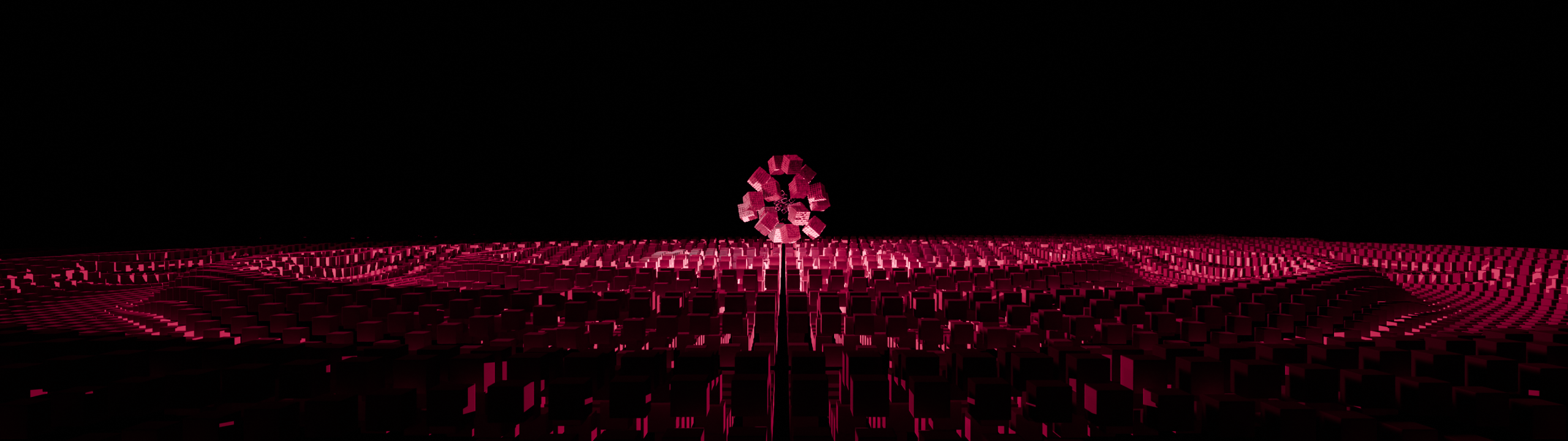
The Hub became a glowing central organism, pulsing with energy and expanding outward. Cubes orbiting the core represented learners, programs, and opportunities spreading across the Arab world. The Hub’s brand colors carried the emotional arc of the story: teal for mission and reach, burgundy for the challenges the Hub pushed through, purple for innovation and outreach, yellow for growth and momentum.
When Lebanon’s crises hit in the narrative timeline, the light dimmed. When the Hub adapted and kept running, the energy surged back. When impact numbers appeared, the cubes multiplied and spread across a map of the region.
No narration needed. The visual logic was the story.
This approach served two purposes. It gave AUB and the Hub an emotionally resonant representation that did not rely on sensitive or contested imagery. And it created something audiences had not seen attached to an educational institution in this region before, a full cinematic world built entirely around one organization’s purpose.
Three Installations, One Immersive Experience Design The immersive experience ran across three interconnected elements, each designed to work as a standalone moment and as part of a coherent whole.
The Cinematic 3D LED Animation The anchor of the experience was a 4-minute 3D LED animation played on the main wall inside the auditorium, a screen spanning 12.5 meters wide and 9.5 meters high. This cinematic film moved through the Hub’s entire story, from founding vision to present impact, without a single slide or spoken word.
The animation opened with the two partner logos colliding and merging into the Hub’s glowing core. It moved through the mission, the crises, the programs, the growth in graduates, and the regional expansion. It closed on a network of light spreading outward with no visible boundary, with the final line: “This is only the beginning. The story is still being written.”
The auditorium went quiet during the screening. Then people started filming it on their phones.
The decision to open with the two institutional logos colliding and merging into a single core was intentional. It established, in the first five seconds, that this was not a presentation about a partnership. It was a demonstration of what happens when two institutions move in the same direction with enough force. The rest of the film followed that energy, building scene by scene through the Hub’s timeline without a single moment of conventional presentation design. No lower thirds. No explainer text. Every data point translated into motion.
The FEA AI Installation FEA was the Hub’s existing AI persona, living on a screen, used for digital content. We brought her into the physical space of the summit and turned her into a live interactive AI installation.
Positioned as a concierge at the entrance of the event, FEA answered real questions from attendees in real time: program details, application processes, session schedules, speaker backgrounds. She guided visitors through the summit agenda and introduced keynote speakers from the stage.
The technology behind it was a custom-built live response system developed entirely by our team. What the audience experienced was something genuinely new at an academic event in the region: an AI that looked back at you, listened, and responded.
FEA became the most-shared element of the summit on social media and introduced a category of AI installation event technology that regional audiences had not encountered before in an academic setting. She positioned the Hub as an institution operating at the frontier of what education can look and feel like.
What made FEA’s installation different from a standard digital kiosk or FAQ screen was the quality of the response system and the physicality of the experience. Visitors were not clicking through a menu. They were having a conversation with something that looked back at them. For an academic summit focused on the future of digital education, the symbolism was hard to miss: the most talked-about element of the event was itself an example of what the Hub’s programs are training people to build and use. The medium was the message.
The Interactive Digital Wall Outside the main hall, a 9-meter LED wall divided into three interactive zones carried the practical layer of the summit. Zone one displayed the full program catalog with tappable details. Zone two told the Hub’s story through scrollable milestones and regional partnerships. Zone three housed the live summit agenda, filterable by strand, time, and format, with real-time updates.
No printed guides. No static banners. Every surface in the space was part of the same designed digital event experience, from the lobby to the auditorium.
The wall also solved a practical problem that most large-scale events handle badly: information access. At a two-day summit with multiple strands, keynotes, workshops, and parallel sessions, attendees often lose track of what is happening where and when. The interactive agenda zone eliminated that friction entirely. Attendees could filter by format, strand, or time, and the real-time update capability meant the wall reflected last-minute changes instantly. The result was a surface that was both atmospherically consistent with the rest of the immersive experience design and operationally useful throughout the entire event.
What Execution Actually Requires The visual work is what people remember. The operational work is what makes it possible.
Our team handled the full scope: concept development, visual design, 3D LED animation production, FEA live system development, digital wall content and interaction design, supplier coordination, and on-site management across both summit days. Every element of the physical environment was managed and maintained by Cre8mania from setup to close.
For an institution like AUB, this kind of project demands more than creative output. It requires a partner that understands institutional stakes, communicates clearly at every stage, and delivers with zero margin for error. That is what our account and production team provided.
The Result AUB’s team described the experience as “submerging into the story without getting bored.”
That sentence is the brief, answered.
The summit generated significant social media activity, driven primarily by FEA, who represented a technology that felt genuinely new to regional audiences. The event positioned AUB and the Abdulla Al Ghurair Hub as institutions at the forefront of academic innovation, not just in curriculum, but in how they communicate who they are.
For a room full of educators, administrators, and industry professionals, the experience demonstrated something no slide deck can: that the Hub’s commitment to innovation is not a talking point. It is the atmosphere they create.
You can learn more about the TransformED Summit at aub-transformed.com .
What Immersive Experience Design Can Do for Your Event The most valuable events are not the ones with the biggest stages. They are the ones where the audience leaves with a feeling they cannot fully explain and a memory that does not fade.
Immersive experience design is not a production upgrade. It is a strategic decision about how seriously you take the people in the room, and how much your story is worth communicating properly.
If you are planning an event, a summit, a launch, or an institutional moment that needs to land with real weight, this is the kind of thinking we bring to every project.