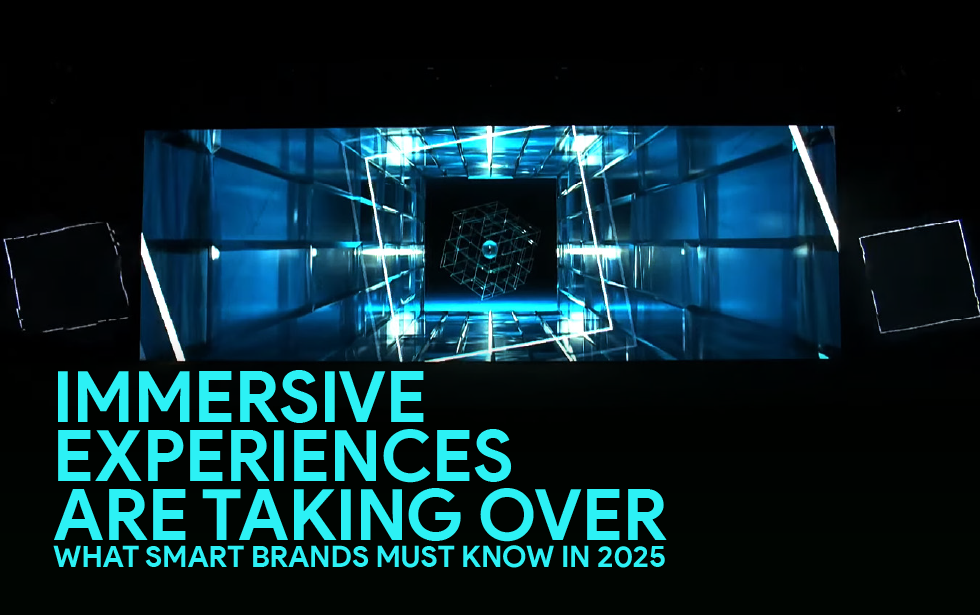
In today’s overstimulated world, consumers don’t just want to see; they want to feel, interact, and belong. As attention spans shrink and traditional advertisements blur into background noise, immersive experiences are rising above the clutter.
In today’s overstimulated world, consumers don’t just want to see; they want to feel, interact, and belong.
As attention spans shrink and traditional advertisements blur into background noise, immersive experiences are rising above the clutter.
In this post, we will argue that immersive storytelling is no longer a novelty; it is the new currency of connection, and the most forward-thinking brands are already building entire worlds their audiences can step into.
While traditional marketing speaks to people, immersive experiences speak through them, turning campaigns into memories.
You will discover what immersive experiences are, why they matter in 2025, and how your brand can shift from flat messaging to full-body engagement.

The Evolution of Engagement: Beyond Traditional Marketing
For years, traditional marketing has relied on a simple formula: visual appeal, clever slogans, and calls to action.
For a while, it worked. Billboards turned heads in the past. Commercials left catchphrases in the living room. Social media advertisements captured clicks.
However, today’s audience is evolving.
We live in a hyper-digital world where consumers are bombarded with content every second. Static visuals barely register. Generic messaging, as marketing expert (Seth Godin, 2018) argues, has become invisible noise.
Even videos, the crown jewel of engagement, are often skipped, muted, or forgotten. This is not just a feeling; a recent analysis shows a massive shift in how people spend, with a growing preference for products that deliver experiences (McKinsey & Company, 2025)
However, most brands are still playing catch-up. They pour budgets into campaigns that spark short-term attention but leave no long-term impression. What is missing is not creativity. It’s presence.
This is where immersive experiences come in, not as a trend, but as an evolution that lasts.
What Are Immersive Experiences?

An immersive experience is an environment, digital, physical, or a hybrid of both, that pulls a participant into a simulated world or narrative.
Unlike passive media, it intentionally blurs the line between the observer and participant by engaging multiple senses and inviting interaction.
The goal is to generate a state of “presence,” a psychological phenomenon where a person feels they are truly “there” within the mediated environment (Lombard & Ditton, 1997).
This creates a powerful and memorable connection that cannot be replicated through passive viewing.
The Key Elements of Immersion
Truly immersive experiences are built on three fundamental pillars.
- A Sense of Presence: You do not just watch; you feel physically and psychologically situated inside the experience.
- Multisensory Design: The experience goes beyond sight and sound to incorporate other senses, such as touch, movement, and tangible awareness of space. This deepens the feeling of reality (Krishna, 2012)
- Emotional Engagement: The narrative and interactions are designed to evoke genuine emotions, such as awe, wonder, nostalgia, or excitement, that are felt deeply and remembered long after the experience ends.
See how we brought immersive experiences to life in our latest portfolio projects
Common Forms in Today’s Market:
Immersive technologies are not gimmicks; they are powerful storytelling gateways. In Beirut and around the world, we see them used in increasingly creative ways.
- Virtual and Augmented Reality (VR/AR): Fully simulated or digitally enhanced environments that users can explore.
- Projection Mapping: Transforming architectural surfaces, like the stunning facades in Downtown Beirut, into dynamic, living canvases for stories.
- Interactive Installations: Physical spaces in galleries, museums, or events that respond directly to a person’s touch, motion, or voice.
- Themed Environments: From escape rooms to large-scale brand activations, these are real-world spaces built for physical and narrative exploration.
At Cre8mania, we believe that the future of branding does not live in pixels or slogans; it lives in these worlds. Worlds your audience can walk through, interact with, and feel real.. The brands that lead in 2025 will not just be the most visible; they will be the most felt.
Why Immersive Storytelling Matters: The Power of Emotional Connection

In a time when everything is designed to distract, immersive experiences do something radical: they hold attention long enough to create emotion. In branding, emotion is everything.
The foundational concept of the “experience economy” is built on the idea that customers now seek memorable events, not just goods and services (Pine & Gilmore 2020).
Brands that embrace immersive storytelling are not just entertaining; they are building emotional equity. They shape how people feel about them, not just what people know.
Research has confirmed that when brands come to life in physical, interactive settings, they foster a deeper sense of connection and brand love (Van Kerrebroeck, Brengman & Willems, 2017). These feelings turn into word-of-mouth, virality, loyalty, and conversions.
However, ignoring this shift comes at a cost.
Brands that remain static, flat, traditional, and interruptive will continue to pour energy into content that is swiped past. Meanwhile, those who build immersive experiences will own the future.
Immersive experiences may sound futuristic, but incorporating them into a brand strategy is achievable. It begins with a few bold shifts in perspectives.
1. Start With Emotion, Not Just Execution
Before asking, “What technology should we use?” ask, “What do we want people to feel?”
Is it a wonder? Nostalgia? Empowerment? The most successful immersive experiences are built around a core emotion that guides every visual, auditory, and interactive element.
As design expert Don Norman (2004) explains, products and experiences that connect with us on an emotional level are more effective and memorable. Technology should always follow the story, not the other way.
At Cre8mania, for instance, emotion guided our work on the Beirut Heritage Festival. We focused on evoking a sense of shared history and civic pride, using technology as a tool to bring these feelings to life.
2. Reimagine the Space Around Your Brand
Instead of thinking in terms of screens or slides, think in terms of the environment. Space is no longer just a physical location; it is a programmable canvas for the story.
This shift invites us to ask transformative questions.
- What if your next product launch was held inside a projection-mapped building that reacted to the crowd?
- What if your brand’s history was unfolded as an interactive installation at a major cultural event?
When you stop thinking about a campaign and start thinking about creating a “world,” you unlock a new level of engagement. What would your brand’s world look, sound, and feel like?
3. Collaborate with Story Architects, Not Just Designers
Creating immersive experiences is an interdisciplinary art form. It requires a fusion of talents: storytellers, sound designers, animators, spatial thinkers, and technologists who understand how to choreograph attention.
Briefing a vendor is not sufficient. To build a world, you must collaborate with a creative team that thinks in dimensions and moments–not just visuals.
Therefore, it is critical to look for partners whose portfolios showcase diverse, story-driven immersive projects, proving that they can orchestrate a complete sensory journey.
The Future of Branding: Beyond Messages, Into Memories

In a world oversaturated with noise, immersive experiences do not merely cut through; they transform. They shift your brand from a message into a memory, a core principle of the modern “experience economy” where what people remember is what truly matters (Pine & Gilmore 2020).
This is no longer a question of technology; it is a question of connection.
So, as you plan your next campaign or launch, ask yourself: Why just tell your audience a story when you can invite them to live inside it?
Let’s Create the Unforgettable
Summer 2025 is in full swing, and Beirut’s vibrant event calendar is the ultimate stage for brand storytelling. At Cre8mania, we believe creativity meets technology in every pixel.
This is the moment to connect with an audience that craves genuine and memorable interactions.
Are you ready to build a world they will not want to leave?
Let’s talk.
Reference List:
- Godin, S. (2018). This is marketing: You can’t be seen until you learn to see. Portfolio/Penguin. Retrieved from https://www.penguinrandomhouse.com/books/600458/this-is-marketing-by-seth-godin/
- Lombard, M., & Ditton, T. (1997). At the heart of it all: The concept of presence. Journal of Computer-Mediated Communication, 3(2). https://academic.oup.com/jcmc/article/3/2/JCMC321/4080403
- McKinsey & Company. (2025). State of the consumer 2025. https://www.mckinsey.com/industries/consumer-packaged-goods/our-insights/state-of-consumer
- Pine, B. J., & Gilmore, J. H. (2020). The experience economy: Competing for customer time, attention, and money (Updated ed.). Harvard Business Review Press. Retrieved from https://www.porchlightbooks.com/products/experience-economy-updated-b-joseph-pine-9781422161975
- Van Kerrebroeck, H., Brengman, M., & Willems, K. (2017). When brands come to life: Experimental research on the impact of brand personification in a branded event. Journal of Business Research, 72, 165–174. https://researchportal.vub.be/en/publications/when-brands-come-to-life-experimental-research-on-the-vividness-e-2
- Krishna, A. (2012). An integrative review of sensory marketing: Engaging the senses to affect perception, judgment and behavior. Journal of Consumer Psychology, 22(3), 332–351. https://www.sciencedirect.com/science/article/abs/pii/S1057740811000830